Saturday, 3 February 2018

Week 2 (FYP 2)


DESIGN PROJECT HARDWARE AND SOFTWARE (cont)


This week I have been meet my co-supervisor to discuss about my progress FYP 2 project. We discuss about coding and at the same time he told me to choose that I want to connect massage to the owner with wireless or blue tooth low energy which is either this two is very cheaper and can make the user comfortable to use it. The other information that I can share with you all is this project will detect sound to make every housewife or user alert about gas leakage detector. Before that, my co-supervisor told me to make some research about blue tooth low energy and easy for me to understand so that i can make it later. However, he also told me that this project can make me get the result with two solution which is grafana or MQTT.  MQTT is  (MQ Telemetry Transport or Message Queuing Telemetry Transport) is an ISO standard. 


EXPLANATION OF MQTT


What is MQTT?

MQTT (MQ Telemetry Transport or Message Queuing Telemetry Transport) is an ISO standard (ISO/IEC PRF 20922) publish-subscribe-based messaging protocol. It works on top of the TCP/IP protocol. It is designed for connections with remote locations where a "small code footprint" is required or the network bandwidth is limited. The publish-subscribe messaging pattern requires a message broker. The specification does not specify the meaning of "small code footprint" or the meaning of "limited network bandwidth". Thus, the protocol's availability for use depends on the context. IMQTT-SN  is a variation of the main protocol aimed at embedded devices on non-TCP/IP networks, such as ZigBee.


Why MQTT is used in IoT?

The connected devices need a protocol using which they could communicate only when it is required. Devices with constrained resourcesshould be able to communicate with various other heterogeneous devices. MQTT is described on the mqtt.org siteas a machine - to -machine (M2M) / IoT connectivity protocol. 


Thank you for reading my blog. Later I will update for more progress and have a nice day you alls ☺☺☺☺☺


Saturday, 27 January 2018

Week 1 (FYP 2)


The first week of my FYP 2 project is now begins. So, now I need to continue the progress of my project from FYP 1 that have been left before form last semester. 


Objective:
  • To introduce the FYP 2.
  • To continue the progress from FYP 1.


Conclusion:

The project for "The Development of Gas Leakage Detector for Home Appliance" is now officially start. 


Saturday, 2 December 2017

Week 17 (FYP 1)

PREPARING FOR FINAL EXAM

This week I will not update my progress report because I want to focus on my final exam. But this does not make me think that FYP 1 is over because FYP 2 gives me more challenges I need to make  this project successful and at the same time I will make this project run as usual. I hope you all can be patient to wait for me to update my report on the next semester.

Thanks for not being tired of dropping into my blog and reading some info useful to you all. Until we meet again in the next semester,☺☺..

Saturday, 25 November 2017

Week 16 (FYP 1)


FYP1 PRESENTATION ON WEEK 15


PRESENTATION DAY

             Date: 22th November 2017
Time: 2.30 - 5.30pm
                          Venue: Gemilang Hall, UnikL BMI


Assalamualaikum and hi uols, today is the day when all the candidates are waiting for Final Year Project 1. All candidates of FYP 1 were having the project Proposal Presentation and have been assessed by the given assessors. Before that, all candidates are required to attend 30 minutes early in order to do all setting setup things to give the best performance to access later. However, all candidate need to follow the procedure that have been given then they can start the presentation later. Below are assessors for my Project Proposal Presentation.


After I done the presentation about "THE DEVELOPMENT OF GAS LEAKAGE DETECTOR FOR HOME APPLIANCE",  overall the presentation are going well both of the slide presentation and performance. But, there is some error that I need to re a do again. The advises from my assessor is the objective must do some correction and  objective must be same with the conclusion for the overall project. For my explanation of the running project are very well and can be understood. 


Lastly I want to say thank you to my assessors and especially to my supervisor Sir Shamsul Adlan.☺☺☺☺... Till we meet again in my next updated blog. 


Sunday, 19 November 2017

Week 15 (FYP 1)


PREPARING FOR FYP 1 PRESENTATION

Hai you all, I'm here to update my blog. After done the research and get all finding, so now it's time to conclude all the FYP 1 schedule by preparing the slide presentation that be held on next week on 22th Nov 2017. In this time, I was preparing the slides based on the understanding about this project "The Development of Gas Leakage Detector for Home Appliance"..


Saturday, 11 November 2017

Week 14 (FYP 1)


Journal 3

Today I will share some knowledge in journal 3, about the history of gas leak detector, who was use the first gas detector  and function, and the world first gas detector company?


History of gas leak detector.

Gas leak detection methods became a concern after the effects of harmful gasses on human health were discovered. Before modern electronics sensors, aerly detection methods relied on less precise detectors. Through the 19th and early 20th centuries, coal miners would bring canaries down to the tunnels with them as an early detection system against life-threatening gasses such as carbon dioxide, carbon monoxide, and methane. 


Who was use the first gas detector and function?

The first gas detector in the industrial age was The flame Safety Lamp (or Davey's Lamp) was invented by Sir Humphry Davey (of England) in 1815 to detect the presence of Methane (Firedamp) in underground coal mines. The Flame Safety Lamp consisted of an oil flame adjusted to specific height in fresh air. To prevent ignition with the lamps flames height varied depending on the sleeve with a mesh flame arrestor. The flames height varied depending on the presence of Methane (higher) or the lack of Oxygen (lower). To this day, in certain parts of the world Flame Safety Lamps are still in service. 


The worlds first gas detector company?

The worlds first gas detection company is Johnson-Williams Instruments (or J-W Instruments) was formed in 1928 in Palo Alto, CA by Dr. Oliver  Johnson and Phil Williams. J-W Instruments is organized as the first electronics company in Silicon Valley over the next 40 years J-W Instruments pioneered many "firsts" in the moderm age of gas detection, including making instruments smaller and more portable, development of a portable Oxygen detector as well as the first combination instrument that could detect both combustible gases/vapors as well as Oxygen. 

 Credit to: Akshay and Ashwin (July 2017) "Gas Leak detector using Arduino UNO Microcontroller. 


I hope you guys can get some information about this journal and hope you all can enjoy this video later. Have a nice day :) :) 


Saturday, 4 November 2017

Week 13 (FYP 1)


LITERATURE REVIEW 


Journal 3

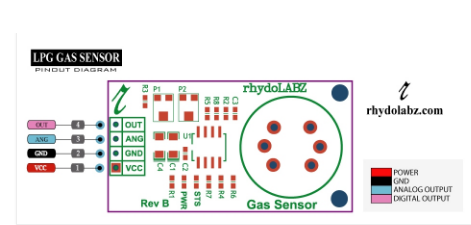
Today I want to share to all of you about sensor. What is gas sensor MQ-5, MQ-5 sensor pin diagram and working principle of gas sensor MQ-5.


What is gas sensor MQ-5?
The Grove - Gas Sensor (MQ-5) module is useful for gas leakage detection (in home and industry). It is suitable for detecting H2, LPG, CH4, CO, and Alcohol. Due its high sensitivity and fast response time, measurements can be taken as soon as possible. The sensitivity of the sensor can be adjusted by using the potentiometer.  

MQ-5 sensor pin diagram


Working principle of gas sensor MQ-5 

This sensor has a sensitive filament made of SnO2. In this presenceof clean air, this filament tends to have lower electrical conductivity. When a combustible gas such as LPG is introduced, the filament's conductivity rises, and the amount of change in it's conductance/resistance can be used to indicate the equivalent gas concentration. This effect tends to be particularly pronounced at higher temperatures, and resisitive heating element is present as well. SnO2 is particularly sensitive to Methane, Butane and Propane, but also sensitive to other combustible gases as well.  


Credit to: Akshay and Ashwin (July 2017) "Gas Leakage Detector using Arduino UNO Microcontroller". 


I hope after reading what have I been share, you guys can get more input about it. TQ for reading my blog and have a nice day =) =)